The Origin of Side-Leg Carry: How Gunpant Invented a New Category
Every product category has a moment of origin — a specific frustration, observation, or question that made someone stop and say: this shouldn't be this hard.
For side-leg carry, that moment came from a simple observation: after years of carrying in demanding environments as a USAF Pararescue operator, and then returning to civilian life, the standard options for concealed carry were surprisingly bad. Not bad as in uncomfortable once in a while. Bad as in: built without any apparent consideration of how people actually move, sit, drive, or go about a normal day.
The Problem Was the Starting Point
Traditional concealed carry positions — waistband, appendix, small-of-back — were developed when holster technology was the primary engineering concern. The garment was an afterthought. Carry clothing meant pants with a bigger waistband or a looser cut to accommodate a belt and holster.
Nobody had asked the more fundamental question: where on the body does a carried load actually make sense?
The waistline is one of the worst possible answers to that question. It's a high-motion zone — every step, every seated position, every twist compresses and stretches the fabric differently. A firearm at the waistline is fighting your body's movement all day. That's why it's uncomfortable. That's why people adjust, shift, and ultimately leave it home.
Starting From the Body
The question that started Gunpant wasn't "how do we make a better holster?" It was more basic: where on the body moves predictably enough to anchor a carried object consistently?
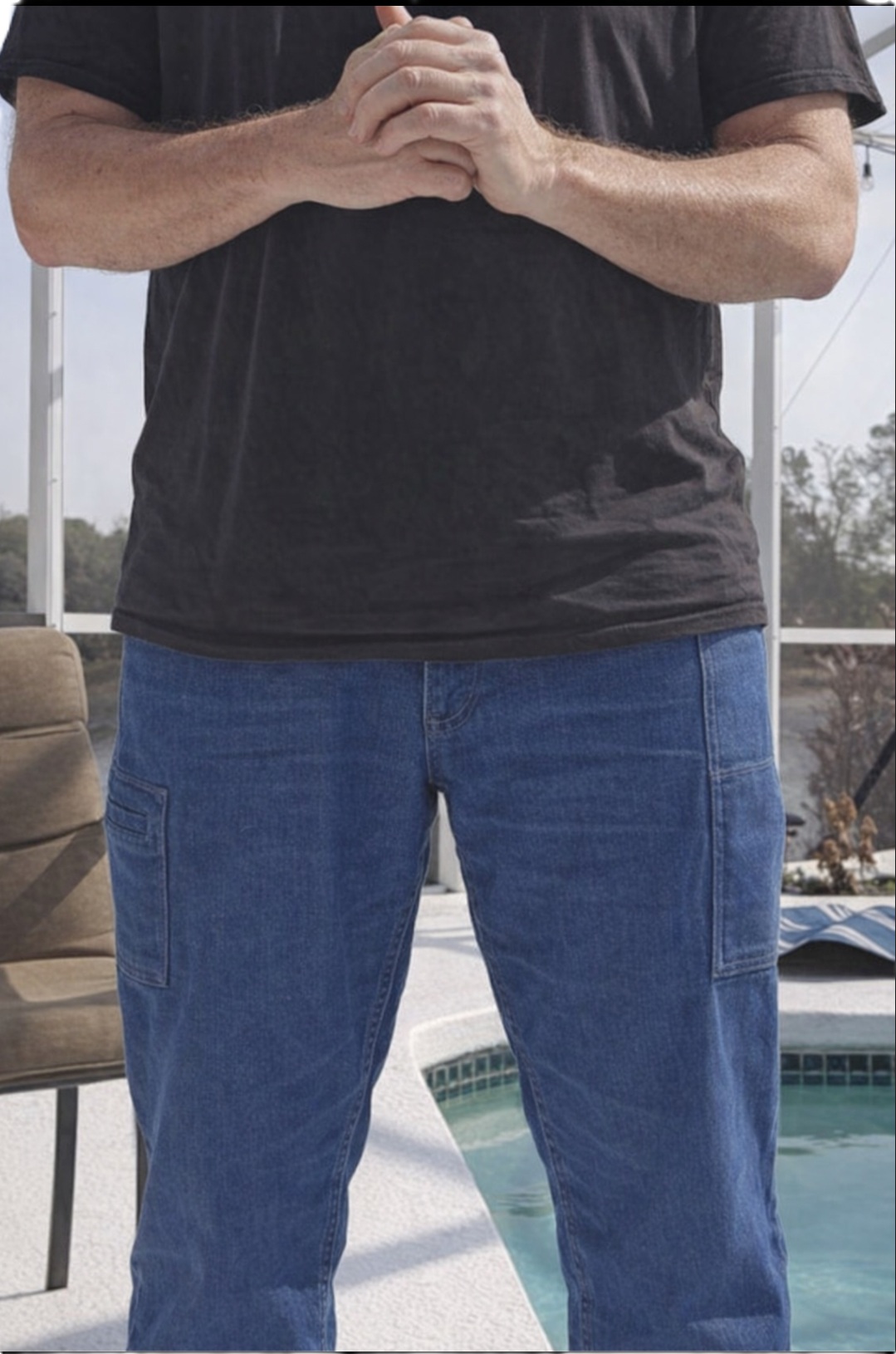
The answer was the outer thigh. The lateral thigh moves in a simple, consistent arc — forward and back, with minimal rotation. It doesn't compress against a seatbelt. It doesn't fold when you sit. The fabric over the outer thigh doesn't stretch and relax with every breath the way fabric over the abdomen does.
That observation became a design principle: build the pocket around a location that works with the body, not against it.
From Observation to Architecture
Moving carry to the outer thigh was step one. The pocket itself still had to be engineered from scratch — standard pockets aren't designed to hold anything heavier than keys without collapsing, rotating, or printing badly.
Three things had to be built into the garment:
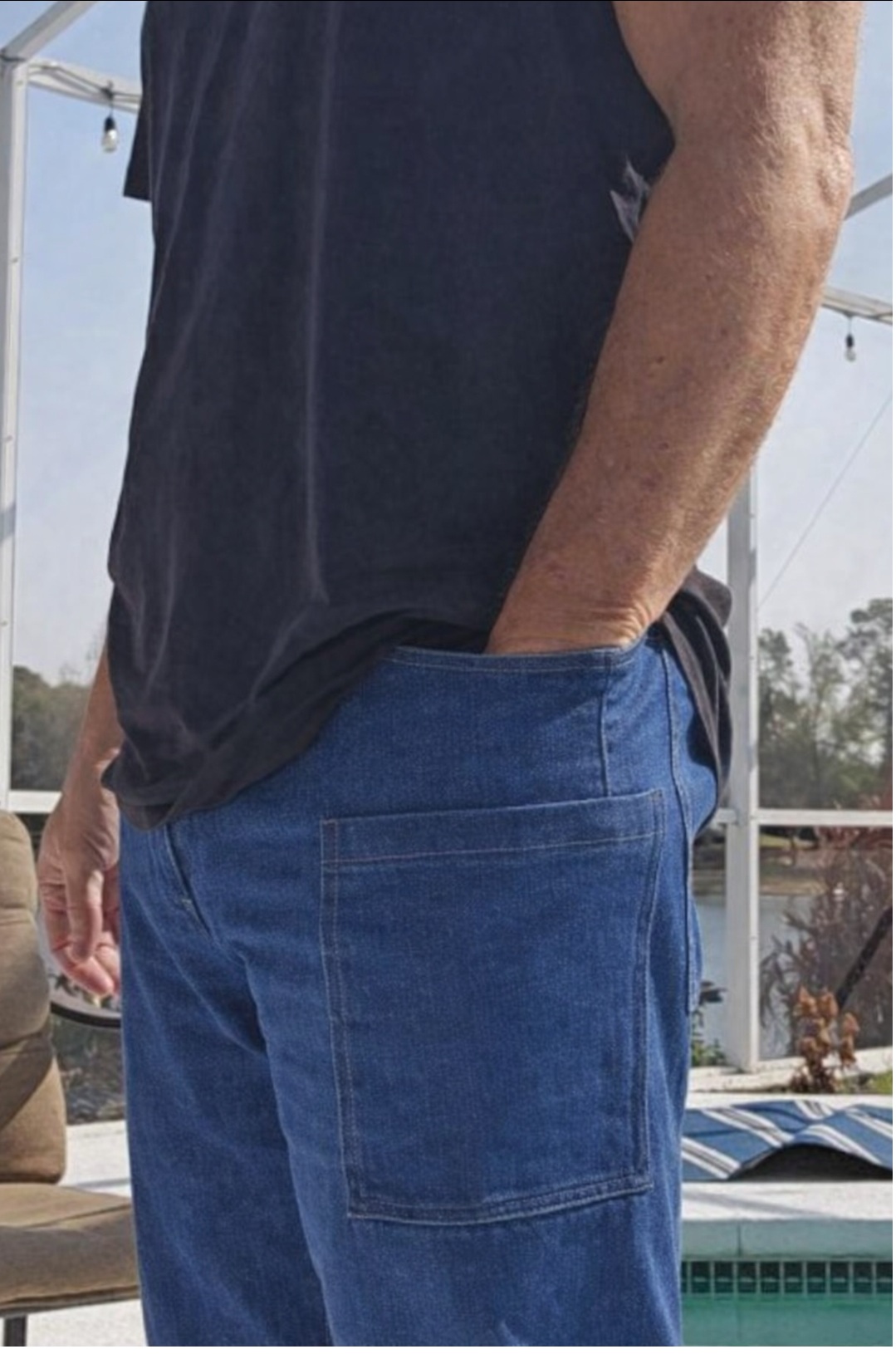
- A wider opening. Seven inches — wide enough that access doesn't require hunting or fabric manipulation. Shaped to allow a direct, upward entry from the side.
- Internal stabilization. The pocket needed to be anchored to the pant leg so it couldn't swing or collapse under weight. Stitched in, not hanging free.
- Orientation geometry. Four internal contact points that guide the firearm into a consistent position each time — so the carrier isn't resetting it every time they stand up or change positions.
These three elements — placement, opening, and geometry — are what became the Gunpant patent-pending pocket system.
A New Category, Not a New Product
What emerged wasn't a variation on existing carry clothing. It was something that didn't exist before: a garment designed from the outside in, where the carry system is the starting point and the pant is built around it.
That's the distinction that matters. Every other piece of concealed carry clothing starts with a normal pair of pants and adds carry capability. Gunpant starts with the carry problem and builds the garment to solve it.
Side-leg carry is a category because the underlying architecture — outer-thigh placement, engineered opening, internal orientation geometry — is a repeatable design approach that can be applied across garments. The jeans were first. The shorts came next. The principle is the same in both.
The category didn't exist before Gunpant. Now it does.