
Side-Leg Carry Jeans
A Category Gunpant Invented
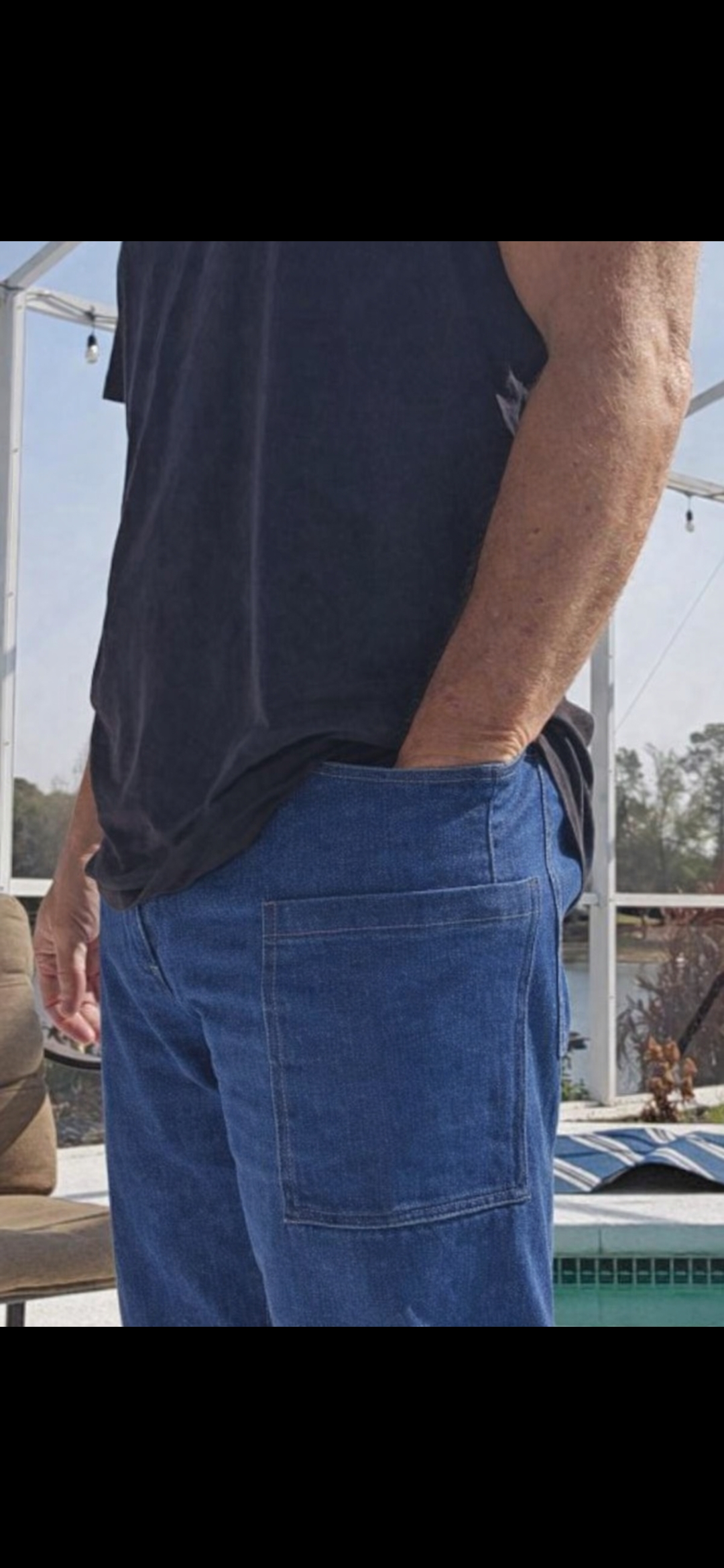
Side-leg concealed carry is a patent-pending apparel innovation that relocates carry to the outer seam of the leg — where the hand naturally rests — using a purpose-engineered pocket built directly into the garment. No holster. No external hardware. No tactical appearance. Gunpant is the originator of this category, created by a former USAF Pararescue operator who rebuilt the concept from first principles.
How the pocket system works →- Patent-pending side-leg placement
- 7-inch wide engineered opening
- Patent-pending four-point stabilization
- Garment-integrated — no external gear
- Natural hand position at rest
What Is Side-Leg Concealed Carry?
Side-leg concealed carry is an apparel-based carry method in which a firearm is carried inside a purpose-shaped pocket integrated into the outer side seam of the leg. The pocket is not a repurposed standard pocket — it is engineered specifically for carry, with a wider opening, internal geometry to orient the firearm consistently, and stitched anchoring to prevent shifting under weight. The garment is the carry system. No external holster, clip, or hardware is required.
This category was invented by Gunpant Inc. and is the subject of a patent-pending application. Prior to Gunpant, no manufacturer had designed a garment around side-leg carry geometry as a primary function — waistband and front-pocket methods had remained the default for decades despite their well-known ergonomic limitations.
Why Side-Leg Carry Needed to Be Invented
Traditional concealed carry methods rely on waistband placement or repurposed pockets — neither was designed around real movement or natural body mechanics. See how Gunpant addresses each problem → · Why traditional carry fails →
Waistband Discomfort
Hip-based placement creates pressure points, shifts during movement, and restricts comfort when sitting or driving for extended periods. Reaching across the body is an unnatural motion that most people cannot perform discreetly.
Pockets Not Engineered for Carry
Standard pockets collapse, rotate, and offer no consistent orientation or stability under the weight of a firearm. They were designed for keys and wallets — not for a purpose that requires repeatability and access under stress.
No Natural Resting Posture
Neither waistband nor pocket carry aligns with where the hand naturally rests at the side of the body. Side-leg placement corrects this: the firearm sits where the hand already is, requiring less deliberate repositioning to access.
Side-Leg vs. IWB vs. Pocket Carry
How the three main civilian carry methods compare across the factors that matter in daily use.
| Factor | Side-Leg (Gunpant) | IWB / OWB | Standard Pocket |
|---|---|---|---|
| Requires external holster | ✓ No — pocket is the system | Required | Usually required for safety |
| Requires cover garment | ✓ No — integrated into jeans | Typically yes | Sometimes |
| Comfort seated / driving | ✓ High — outer thigh, no hip pressure | Low–Medium — presses into body | Medium — front pocket shifts |
| Natural hand position at rest | ✓ Yes — hand rests at outer thigh | No — cross-body reach | No — forward reach |
| Firearm orientation consistency | ✓ High — four-point internal geometry | High (with quality holster) | Low — rotates freely |
| Engineered for carry | ✓ Yes — patent-pending system | Holster yes, garment no | No — repurposed design |
| Normal clothing appearance | ✓ Yes — standard denim look | Depends on cover garment | Usually yes |
Comparison reflects general characteristics. Individual results vary by firearm, body type, and specific product. IWB/OWB holsters used correctly by trained carriers may outperform any garment-based system on retention and safety metrics.
The Engineering Behind Side-Leg Carry
A category defined by geometry, placement, and internal architecture — not by marketing terms. Full pocket architecture breakdown → · Pocket architecture explained →
7-Inch Engineered Opening
Standard pockets use a 3–4 inch opening. Gunpant expands this to 7 inches with a smooth opening engineered around real firearm dimensions — reducing material interference and allowing a more natural, direct hand entry from the side of the leg.
Patent-Pending Side-Leg Placement
Relocated from the hip to the outer vertical seam of the leg, aligning with the body's natural resting arm position. Less reach, less posture correction, more daily comfort across sitting, standing, walking, and driving.
Four-Point Stabilization Geometry
A patent-pending internal architecture uses four stitched reference points to help compact and mid-size firearms settle into a more repeatable orientation automatically — without the carrier having to manually set the firearm each time.
The Origin of the Category
Side-leg concealed carry was created by a former USAF Pararescue operator who experienced firsthand the limitations of traditional carry after leaving military service. Civilian waistband carry felt uncomfortable and restrictive. Standard pocket carry provided no consistency or stability. Neither method was built around how the human body actually moves or where the hand naturally rests.
Drawing from operational experience and an engineering approach, he rebuilt the concept from first principles: widen the opening, relocate the pocket to the outer leg seam, and add internal structure to create orientation consistency. The result was not an improved pocket — it was a new category of garment.
Gunpant Inc. is the first and only company to design, file a patent application for, and manufacture side-leg carry jeans and shorts. Every element — from the pocket geometry to the internal four-point stabilization — was engineered specifically for this purpose, not adapted from existing apparel.
Frequently Asked Questions
What is side-leg concealed carry?
Side-leg concealed carry is an apparel-based carry method where the firearm is carried inside a purpose-engineered pocket along the outer side seam of the leg — not at the waistband and not in a repurposed front pocket. The pocket is shaped, anchored, and internally structured specifically for carry. It was invented by Gunpant Inc. and is the subject of a patent-pending application.
Who invented side-leg carry jeans?
Gunpant Inc. invented the side-leg carry jean category. The system was developed by the company's founder, a former USAF Pararescue operator, and is the subject of a patent-pending application covering the side-leg placement, pocket geometry, and internal four-point stabilization architecture. No other manufacturer had brought this category to market prior to Gunpant.
How is side-leg carry different from IWB or OWB carry?
IWB (inside-the-waistband) and OWB (outside-the-waistband) carry place the firearm at the hip and require a dedicated external holster. Side-leg carry integrates the carry pocket directly into the garment at the outer thigh — no separate holster needed — and positions the firearm where the hand naturally rests at the side of the leg, reducing reach and the postural shift required for access.
Is a side-leg carry garment a holster?
No. Gunpant side-leg carry jeans and shorts are garments, not holsters. They are not a retention device, safety device, or substitute for proper firearm training and safe handling practices. Users are responsible for complying with all applicable laws, including any jurisdiction-specific requirements for holster use.
What firearms are compatible with side-leg carry jeans?
The pocket system is designed around compact and mid-size carry firearms. For the four-point catch geometry to seat the firearm correctly, two zones must be clear: the first five inches of the barrel from the muzzle end along the top, and the underside of the barrel and area in front of the trigger guard. Weapon lights, rail-mounted lasers, and most barrel-mounted accessories will interfere with seating. Red-dot and green-dot optics can be compatible if mounted far enough back on the slide that they do not fall within the first five inches from the muzzle — though this depends on the specific optic and firearm. Compatibility also depends on overall firearm dimensions and individual body type. Gunpant does not endorse specific firearm models or guarantee compatibility with any particular firearm.
Can I use side-leg carry jeans with a red dot or weapon light attached?
It depends on where the accessory is mounted. Weapon lights and rail-mounted accessories on the underside of the barrel are not compatible — they prevent the firearm from seating into the catch system. Red-dot and green-dot optics can be compatible if mounted at the rear of the slide above the grip. The optic must not extend forward over the trigger or trigger guard area — if it does, it will interfere with the catch geometry. An optic sitting entirely behind the trigger guard stays clear of the system. When in doubt, check that the optic is fully behind the trigger guard before using it with Gunpant.
Does Gunpant recommend carrying with a round in the chamber?
No. When carrying in Gunpant jeans, we recommend carrying unchambered. The founder of Gunpant is a former special forces operator — someone with more trigger time than most will ever accumulate — and he carries unchambered when wearing Gunpant. Not out of fear, but out of a clear-eyed understanding that the civilian mission is different from the field. He carries to have the firearm available if the need ever truly arises. That is the mission. Side-leg carry makes the gun accessible and comfortable for daily life — and carrying unchambered is the responsible approach within that system. If you ever reach for it in a real situation, you will still be thinking. Carry like it.
Gunpant Inc. — First to Design, Patent, and Manufacture Side-Leg Carry Jeans
Every element of the Gunpant system — pocket geometry, opening dimensions, internal stabilization, and garment-integrated placement — was engineered from scratch for this category. As the originator, Gunpant sets the reference standard for what side-leg carry means as a design discipline.